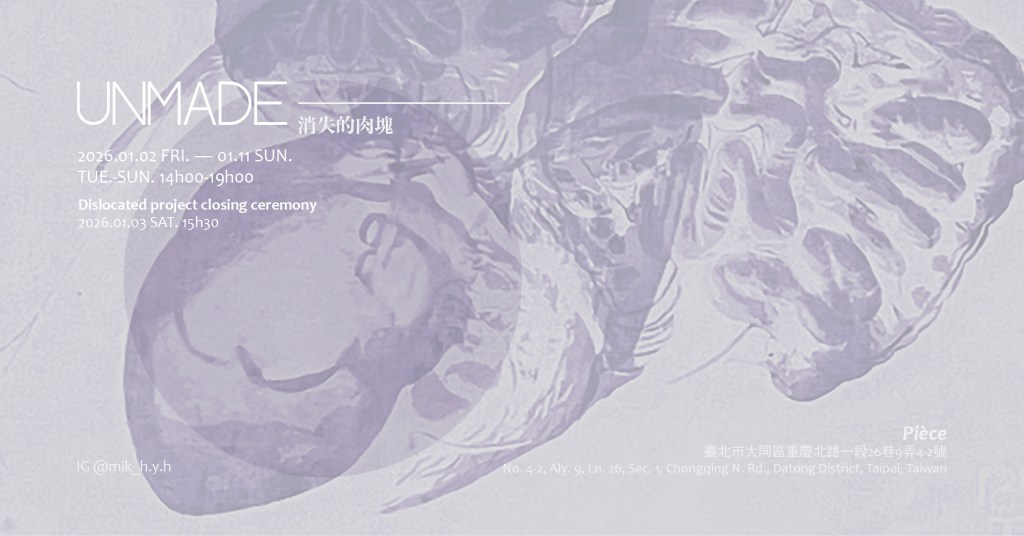
作品本身探索器官的概念性與社會關聯性,將器官視為不僅是身體的一部分,而是社會脈動、階級與經濟價值之間的隱喻。這個過程如同一個社會系統。器官在此不再只是內部結構,而是可被拆解、轉移、交換與再定義的物件。
原本的作品,預計以大量生產並由「中國製造」的器官布偶組成,形成一套模組化的系統,並深植於其社會與經濟脈絡之中。然而,因市場失靈與中國供應商之間的資訊不對稱,生產過程受阻,使原有的生產架構無法實現。「不完整」與「缺失」因此成為作 品所須面對的現實,也揭示了非正式經濟 (地下交易)的運作機制。
當器官被轉化為懸浮於空間中的紙片影像時,它們成為缺失之物的替代品;而這些平面影像,仍持續指向器官在符號與概念上的延續。
The works themselves explore the conceptual and social relevance of organs, seeing them not simply as parts of the body but as metaphors for social dynamics, hierarchy, and economic value. This process is like a social system. Here, organs are no longer merely internal structures, but objects that can be disassembled, transferred, exchanged, and redefined.
Originally, the work was supposed to be composed by mass-produced, Made in China doll organs; a system reflecting its modularity, embedded in its social and economic context. However, market failure and information asymmetries with the Chinese supplier disrupted the process, rendering the production of the original structure impossible. “Incompleteness" and “absence" thus became the realities the work had to confront, and the dynamics of informal economy.
Transformed into paper figures suspended in space, they became substitutes for the absent. These flat images simultaneously point to the continuation of organs as symbols and concepts.
【UNMADE 消失的肉塊:黃馨幼個展】
展覽日期 l 2026.1.2 – 1.11
開放時間 l Tue.-Sun. 14:00 -19:00
展覽地點 l Pièce台北市大同區重慶北路一段26巷9弄4-2號
【藝術家簡歷】
黃馨幼 Kim, HSIN-YU HUANG
長時間的移動與異地生活經驗,使創作深受多元文化與日常生活節奏之間相互影響。在行旅期間,持續觀察各種不同的藝術脈絡,進一步深化了對於文化差異與視覺語言的敏感度。這些經驗不再只是背景,而成為持續累積,並逐步轉化為創作語彙的來源。
這些經驗也深刻地感受對於美感的理解,以及對美學與藝術更為深入的認識,並不再侷限於傳統藝術形式或既有藝廊的框架。透過過往從事設計與織品相關領域的實務經驗,創作逐步轉向更為開放的藝術形式。
創作媒材涵蓋複合媒材、織品與布料等材料,並將材料本身及其結合運用的形式,被視為思考的一部分。藉由解構、重新組構與再構築,以視覺藝術為媒介,引導觀者重新思考社會與文化的多重層次。平面、影像與物件的交錯運用,成為重要的思考與表述方式。
整體而言,創作圍繞著累積的狀態——在移動與停留之間,在生活經驗與場域之間的關係性。
Living in different places and extended periods of displacement have strongly influence the creative practices, grounded in diverse cultures and rhythms of everyday life. Ongoing observation of different artistic contexts during periods of travel has further deepened sensitivity to cultural differences and visual languages. These experiences no longer constitute backgrounds, but accumulate over time and gradually transform into a source of creative vocabulary.
These experiences have strongly informed a sense of beauty and a deeper understanding of aesthetics and art that extends beyond traditional art forms and conventional gallery contexts.
Through previous professional engagement with design and textile-related practices, the work has progressively shifted towards more open artistic forms. The practice encompasses mixed media, textiles, and fabric-based materials. Materials themselves, along with the ways they are combined and deployed, are understood as integral to the process of thinking. Through acts of deconstruction, reconfiguration, and reconstruction, visual art is employed as a medium to invite viewers to reconsider the multiple layers of society and culture. The interweaving of two-dimensional works, moving images, and objects has become a key mode of reflection and expression.
The practice revolves around dynamic states of accumulation, between movements and pause, and within the relational space between lived experiences and places.
 Pièce
Pièce 