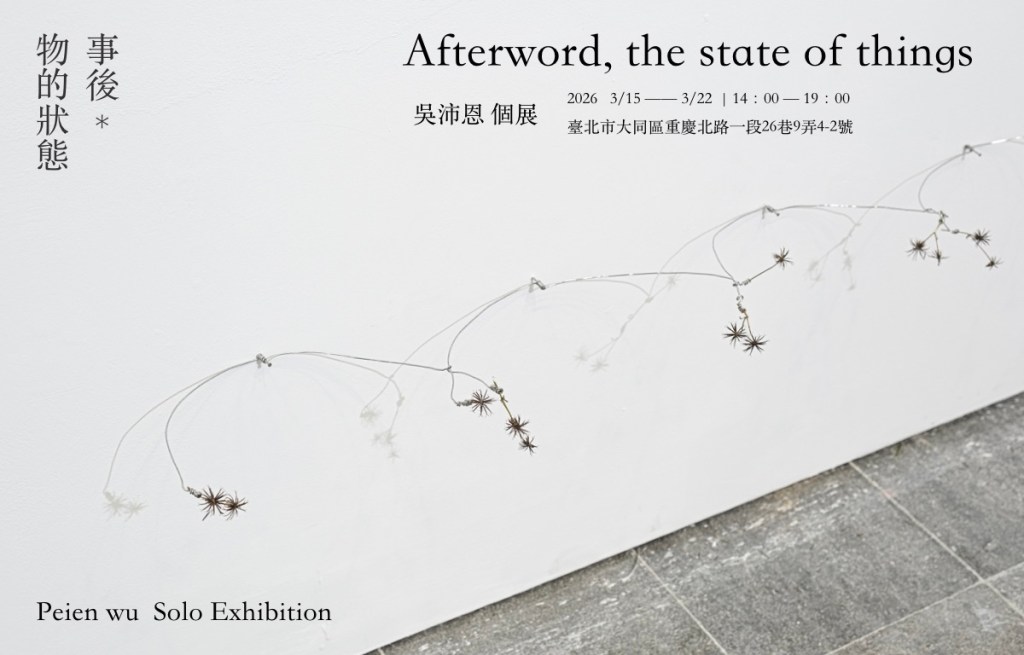
痕跡作為結果佔據空間,透過這些條件回推過去,想像事件如何發⽣。
在草叢中盤旋多久的時間,才促成這如獸⽪般密集的針草叢︔抑或是被隔壁的酒⽔擠壓,進⽽從牆⾯細孔中潺潺開閘的景象。⿃巢下是否不被歡迎站⼈;或是俯下身親吻⾺桶內側的某個性感女⼈︖
這裡的「痕跡」指向某種⾏為或動態。不依賴於象徵或敘事,它更接近⼀種索引狀態,並以其配置與連續性,成為更具說服⼒的形式本身。
因果關係預設著過程的斷缺。我嘗試運⽤這份斷缺,尋找讓事件得以運作的「條件」。有趣的是,
即使「索引」所指向的未必是真實發⽣的事件,它仍可能成為⼀種「啟動推論機制的契機」,甚至進⼀步擴張我們對事件的想像。
因此,即便知道事件未必合乎常理,物質所構成的因果狀態,仍會在某種程度上迫使我們出於本能地建⽴關係。
*
Traces, as outcomes, come to occupy space. From these material conditions, we retroactively infer a past, imagining how an event might have unfolded.
How long must something have circled within the grass to produce a thicket so densely interwoven it resembles animal hide? Or was it the pressure of spilled liquor next door, forcing its way through minute apertures in the wall, seeping outward in a slow release? Is the ground beneath the bird’s nest a site that resists occupation? Or is it a matter of bending down to kiss a certain sexy woman inside the toilet bowl?
Here, “trace” points toward a certain action or dynamic. It does not rely on symbolism or narrative; rather, it approaches a state of index. Through its configuration and continuity, it becomes persuasive as a form in itself.
Causality presupposes a rupture: a gap in the continuity of process. It is precisely within this discontinuity that I seek the operative “conditions” that allow an event to emerge. Crucially, even when the index does not correspond to an empirically verifiable occurrence, it may still function as a catalyst—activating an inferential mechanism and expanding the imaginative field of what could have taken place.
Thus, even when we recognize that the implied event may defy plausibility, the material configuration of cause and effect exerts a certain compulsion. We are driven, almost instinctively, to establish relations—to construct coherence from matter’s residual states.
事後,物的狀態: 吳沛恩個展
展覽日期 l 2026/3/15(日)~ 3/22(日)
開放時間 l 週一至週日 14:00 -19:00
【藝術家簡介】
吳沛恩就讀於國⽴臺北藝術⼤學美術學系。其創作經常構成某種事件的「⽬擊現場」,透過雕塑、裝置與攝影等媒材的配置,營造出指向既已發⽣卻不可⾒之⾏動的物質狀態。觀者在空間中循著物件間的線索進⾏推測時,事件的弔詭性亦隨之浮現。
其作品關注物件造型與材質本身所承載的感知可能,常將風⾺⽜不相及的物件拿來作為特定的語法。以及思考這些靜態元素,在空間中的相互牽動,如何構成推導的條件。不合常理的「事件」所留下的痕跡,並未導向單⼀且確定的事實,反⽽鬆動了按圖索驥式的回溯路徑,使痕跡轉化為⼀種懸置於因果之間的中介環節。
在此脈絡下,物質性除了是結果的遺留,也成為指向不可⾒過程的觸發點。事件並非被完整還原,⽽是在觀者的推論與想像中逐步形成。
近年來,其創作亦延伸至媒材與空間關係的實驗,關注物與物、物與場域之間在觀看動線與時序暗⽰上的構成⽅式。相較於以敘事或議題為核⼼的創作模式,其實踐更側重於狀態的建構與運作機制的⽅法論,並持續關注「索引」作為驅動⼒,如何參與圖像在當代視覺環境中形成共識的過程。
*
*
Wu Pei-En is currently studying in the Department of Fine Arts at the National Taipei University of theArts. His practice often constructs what appears to be the “scene” of an event. Through the configuration ofsculpture, installation, and photography, he creates material states that point toward actions that havealready occurred yet remain unseen. As viewers trace the clues among objects within the space, theparadoxical nature of the event gradually emerges.
His work focuses on the perceptual possibilities carried by the forms and materials of objects themselves.
He frequently brings together seemingly unrelated objects as elements within a specific syntax, whileexamining how these static components interact within space to establish the conditions for inference. The traces left by events that defy common sense do not lead to a single, fixed fact; rather, they loosen any straightforward, map-like route of retrospection, transforming the trace into a mediating link suspended between causes and effects.
Within this context, materiality is not only the residue of a result but also a trigger that points toward an unseen process. The event is not fully reconstructed; instead, it gradually takes shape through the viewer’s inference and imagination.
In recent years, his practice has extended to experiments concerning the relationship between medium and space, with attention to how objects relate to one another and to the site through viewing trajectories and temporal cues. In contrast to modes of practice centered on narrative or thematic discourse, his work emphasizes the construction of states and the methodology of operative mechanisms, while continuing to consider how the “index,” as a driving force, participates in the formation of consensus around images within the contemporary visual environment.
 Pièce
Pièce 
發表留言